Every holiday season brings the same pressure for growing brands: traffic spikes are common, and deadlines become tighter.
Eventually, the question of whether your holiday campaign deserves its own domain starts staring in the face.
As an entrepreneur, your reasons for building a dedicated domain might stem from a higher urgency or wanting your customer’s attention.
Sure, on the surface, it sounds practical, even clever, because a new domain feels like a clean slate.
But domains are not neutral assets. They carry reputation, familiarity, and the invisible weight of past trust.
And let’s not forget, separating a campaign from the main brand can be a risky move.
Customers may be tempted to click, but may step back if the domain address feels unfamiliar (read: unsafe).
On the search engine side, they may index the page, but the signals take time to settle. This is where the decision stops being tactical and starts affecting brand instinct.
The fact is that site owners live in an online space where momentum and credibility constantly pull in different directions.
So, if you want to make the right choice, read on. In this guide, we’ll explore whether temporary domains are worth the effort, time, and well, investment.
What’s a Holiday Campaign Marketing Domain Anyway?
Every serious site owner hits a familiar wall during peak season.
The main site already carries years of structure, approvals, dependencies, and, of course, expectations.
Your product team wants speed while marketing voices flexibility. And when it comes to the leadership, all they want is revenue-driven marketing.
This is where a holiday campaign marketing domain comes into the big picture.
We’d say it’s a standalone web domain created to run time-bound commercial campaigns tied to seasonal demand spikes, such as festivals, year-end sales, and regional shopping events.
The domain operates independently from your primary brand domain and serves a narrow business goal tied to conversions, lead capture, offer-driven traffic, and so on.
Technically speaking, the domain has its own:
- DNS configuration and hosting environment
- URL structure designed for short-term relevance
- Analytics property and attribution setup
- Campaign-specific tracking logic
- Deployment lifecycle tied to a defined start and end date
Takeaway: You are not really extending your main site or “decorating” it for the season. The idea is to build a separate commercial platform that trades brand depth for execution speed. This “trade” transforms how trust is earned, how data flows, and how customers interpret your intent.
Why Should You Care About Holiday Campaign Domains?
Seasonal growth exposes pressure points that stay manageable during regular months. When demand spikes rapidly, the main site often becomes a bottleneck rather than a growth engine. You feel it when teams hesitate, approvals stack up, and every change starts carrying more risk than reward.
Most businesses do not wake up wanting a separate campaign domain. The idea usually surfaces after friction manifests in specific ways that affect speed and revenue.
Operational Friction on the Primary Domain
The core site carries responsibility. Revenue pages, legal language, navigation logic, and brand standards all live there. During high-stakes seasons, these same guardrails slow execution.
You may recognise these constraints:
- Marketing teams wait days for page approvals that should take hours
- Legal and compliance reviews block rapid offer changes
- Core navigation forces campaigns to compete with evergreen pages
- Release cycles delay fixes during live promotions
Each delay costs attention. During holiday windows, attention moves faster than internal processes can keep up.
Risk Aversion During Revenue-Critical Periods
High-revenue weeks create fear of disruption. Teams hesitate to test aggressive layouts or new messaging because rankings, conversions, and site stability feel too important to touch.
Common hesitation patterns include:
- SEO teams pushing back on URL or copy changes
- Product teams avoiding layout experiments
- Engineering teams prioritising uptime over optimisation
- Leadership favours predictability over performance gains
A separate campaign domain provides teams with the flexibility to act decisively while keeping the main site stable.
Speed Becomes the Business Advantage
Holiday campaigns reward fast iteration. Offers change daily. Inventory shifts unexpectedly. Messaging needs adjustment based on real-time demand.
A dedicated domain allows you to:
- Launch pages faster
- Change pricing or copy in real time
- Test multiple offers in parallel
- React to competitor moves within hours
This speed typically becomes the deciding factor in crowded seasonal markets.
Takeaway: Understanding the role of a holiday campaign marketing domain sharpens decision-making before pressure builds. The choice impacts trust signals, operational flow, analytics clarity, and brand memory.
For site owners, the real decision centres on balance. You weigh speed against cohesion. You measure short-term gains against long-term perception. Knowing exactly what you are building helps you exit the season stronger rather than fragmented.
Holiday Marketing and Ecommerce Trends That Elevate Domain Decisions
The numbers emerging for the holiday season make one thing clear: competition, consumer behaviour, and technology are all shifting in ways that directly impact how you think about domains and campaign structure.
Here’s what the data claims:
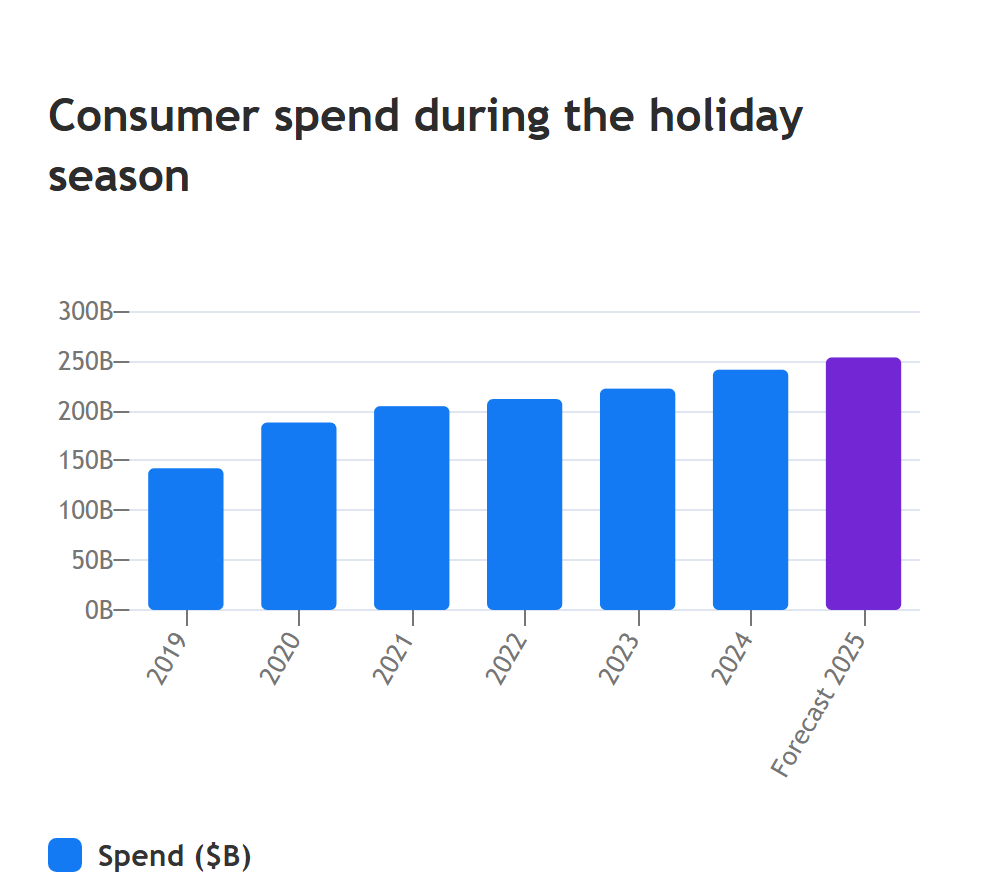
- Global online seasonal spending continues to climb: Adobe forecasts that total online holiday retail sales in 2025 will exceed $253 billion, marking a continued year-on-year increase in consumer demand and digital buying behaviour.
- Mobile remains decisive: Consumers are spending more of their holiday budget on phones, with mobile holiday spend continuing to rise: a trend that reflects how frictionless experiences now drive conversion outcomes.
- Shoppers are activating earlier than ever, with roughly 30% starting holiday shopping in October or sooner: This means your campaigns and domain strategy must be ready well before late November.
- During peak season, bid prices for digital advertising commonly increase by over 140% compared to non-seasonal periods, reflecting the intense competition for visibility.
- Search behaviour underscores why discovery matters and why domains linked to clarity and trust are more valuable than accidental or unfamiliar alternatives: Roughly 90% of holiday shoppers search online for deals before purchasing, indicating that your campaign presence must align with how users are actively seeking offers.
- Holiday campaign infrastructure intersects with brand safety: Analysts reporting on 2025 holiday shopping found that fraudulent domain registrations tied to “Black Friday” keywords spiked significantly, with domain registrations increasing sharply through October and early November, and a measurable portion flagged as malicious. This reinforces the need for your domain strategy to prioritise legitimacy and trust over novelty.
What This Data Mean for You
- Demand continues to grow, so your strategy must support not just seasonal spikes but sustained user confidence
- Mobile and search-driven journeys demand seamless, trusted entry points
- Early planning and visibility are now competitive necessities
- Domain choice influences not just web traffic but credibility in a landscape crowded with opportunistic actors
Translating Market Realities Into Domain Decisions That Matter
| What You’re Experiencing in the Market | The True Cost Most Teams Miss | What You Should Decide Because of It |
| Holiday traffic feels louder and more crowded each year | Attention drops faster than before, even on high-intent clicks | Domains need to reduce doubt instantly, not add novelty |
| Customers start browsing deals earlier than expected | Campaign readiness slips when planning starts too late | Domain structure should be locked well before launch planning |
| Mobile drives a large share of campaign traffic | Users abandon faster when anything feels unfamiliar | New domains must look unmistakably legitimate on first load |
| Paid traffic costs climb sharply during peak weeks | Weak trust signals turn clicks into wasted spend | Avoid domains that require explanation or reassurance |
| Buyers compare offers across tabs before converting | Brand familiarity influences the final choice more than pricing | Campaign domains should reinforce brand memory, not split it |
| Scam offers flood inboxes and ads during sale periods | Shoppers approach unknown URLs defensively | Safer-looking domains convert better than clever ones |
| Campaigns rely heavily on ads and email to drive volume | Short windows limit organic learning and recovery | Do not expect temporary domains to build lasting visibility |
| Leadership asks harder questions after campaigns end | Attribution gaps weaken confidence in results | Fewer domains mean clearer answers and faster decisions |
| Repeat buyers account for a large share of revenue | Post-sale recall influences future conversions | Domain consistency matters after the discount ends |
| Pro Tip: If more than three rows feel uncomfortably familiar, a separate campaign domain will amplify existing weaknesses rather than fix them. |
5 Hidden Risks of Using a Separate Holiday Campaign Domain
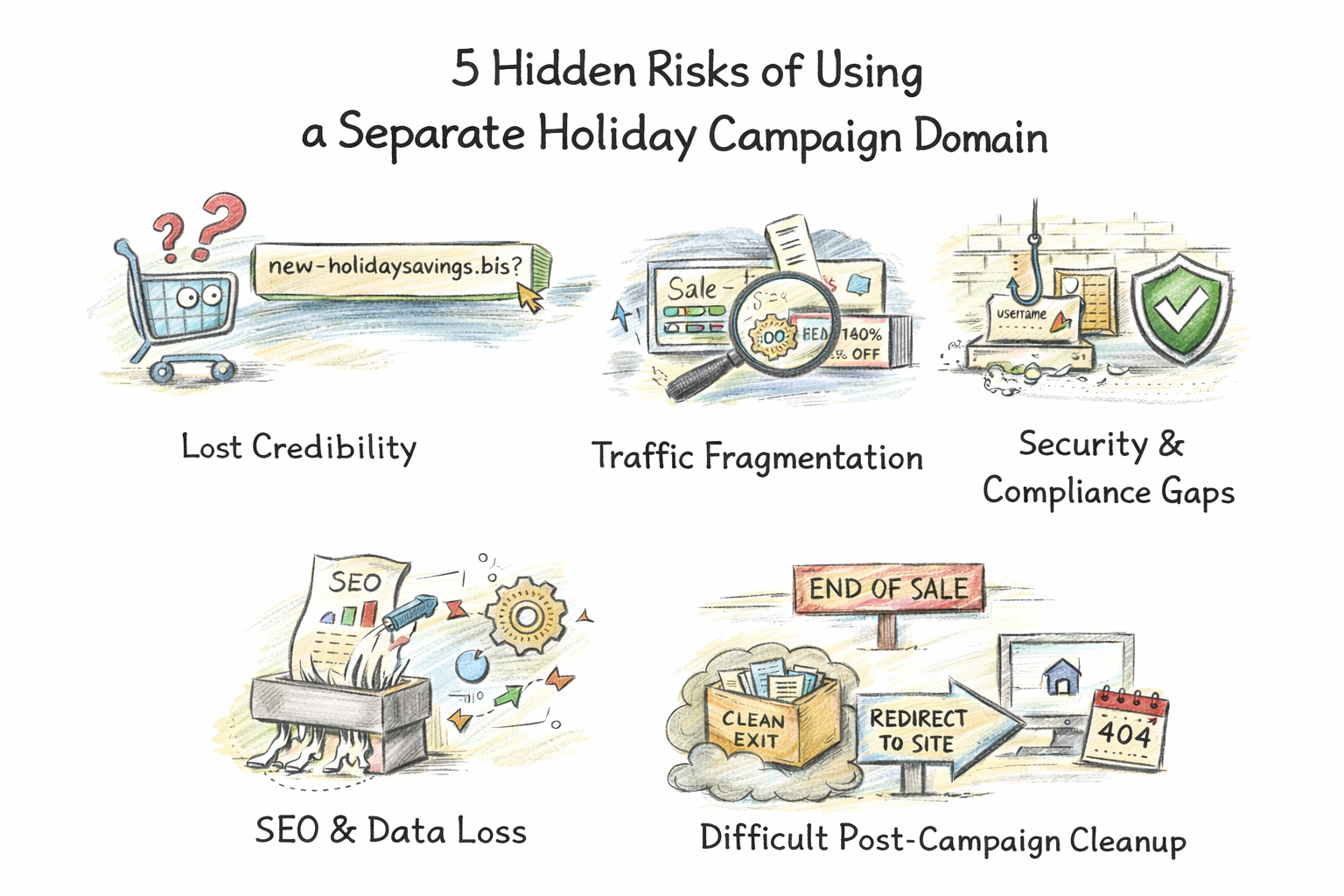
Holiday campaign domains promise speed. What they rarely advertise is the cost that shows up quietly after launch. These risks do not appear in planning decks or early metrics. They surface in user hesitation, reporting gaps, and brand confusion once the rush settles.
Risk #1: Trust Drops at the First Click
Customers arrive during holidays already cautious. Fraud spikes. Fake offers circulate. Inbox clutter peaks. When the domain does not look or feel familiar, doubt creeps in even if the offer is strong.
You see it play out in subtle ways:
- Higher bounce rates from paid traffic
- Users hovering on checkout pages longer than usual
- Drop-offs that do not match intent levels
The issue is not price or product. The issue is confidence. A new domain asks users to trust you faster than usual. Some will. Many will not.
Risk #2: Search Engines Treat Short-Lived Domains Differently
Holiday domains rarely exist long enough to build meaningful search authority. Even when indexed quickly, they operate on borrowed time.
What site owners often overlook:
- Pages indexed during peak weeks lose relevance fast
- Crawl signals reset when domains go dormant
- Redirecting post-campaign traffic rarely transfers full value
Search engines reward consistency. Seasonal domains operate on urgency. Those goals rarely align cleanly.
Risk #3: Analytics Gets Messy When Domains Multiply
Data fragmentation becomes obvious only after leadership asks for clarity. Attribution trails break when users move between your main site and a campaign domain.
Common reporting issues include:
- Paid conversions credited to the wrong source
- Repeat visitors counted as new users
- CRM records missing campaign context
Teams end up reconciling spreadsheets instead of learning from performance. The real cost here is decision quality.
Risk #4: Brand Memory Takes a Subtle Hit
Holiday traffic moves fast. Users remember fewer details. What sticks is how the experience felt.
Repeated exposure to different domains can lead to:
- Lower brand recall after the season
- Confusion about official communication channels
- Reduced trust in future campaigns
Risk #5: Operational Debt Lingers After the Sale Ends
Campaigns shut down. Domains often stay alive longer than intended. Problems that surface later:
- Expired certificates triggering browser warnings
- Old pages resurfacing in search results
- Forgotten redirects confuse returning users
These issues rarely feel urgent in December, but remember that they’ll feel expensive in January.
Takeaway: Speed solves today’s problem, but risk shows up tomorrow. A holiday campaign domain can deliver results quickly, but every shortcut creates responsibility that needs active ownership.
How to Create a Holiday Campaign Domain: Tips and Tricks for SMEs
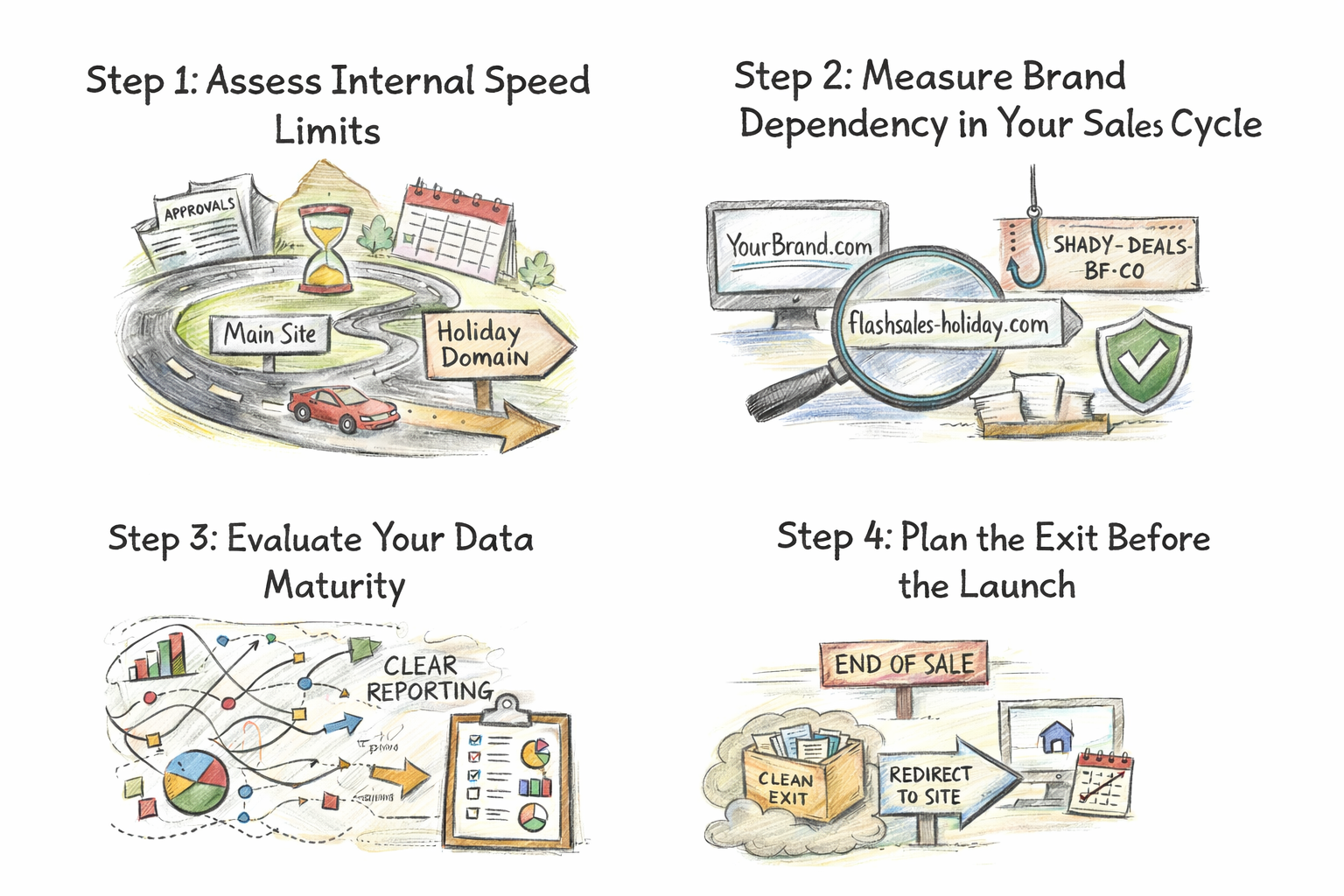
Holiday campaign domains do not sit on a spectrum of right or wrong. They sit in context.
The outcome depends on how your business actually operates when pressure hits (and not how it looks in planning decks or how you want it to scale later).
This framework helps you decide based on constraints you already live with.
Step 1: Assess Internal Speed Limits
Who is it for: Founders, marketing heads, and site owners who feel blocked by internal approvals, slow releases, or fear of breaking revenue-critical pages during peak seasons.
How to implement it:
- Map your actual turnaround time for simple updates during high-traffic weeks as opposed to ideal conditions
- Identify which teams or approvals slow changes and document where delays happen most often
- Separate seasonal experimentation from core site governance to protect stability
- Decide upfront which changes must stay on the main site and which can live elsewhere
Questions you should ask before deciding:
- How long does it take you to push a pricing or copy change today
- Who must approve changes during peak season
- How often do delays cost you real conversions
- What happens when something needs fixing urgently
Step 2: Measure Brand Dependency in Your Sales Cycle
Who is it for: Businesses where trust, reputation, and familiarity influence buying decisions more than discounts or urgency alone.
How to implement it:
- Review conversion paths to see how often users return before buying
- Identify which trust signals drive decisions, such as reviews, brand name, or repeat exposure
- Test campaign messaging on your main domain before isolating it elsewhere
- Strengthen visual and messaging consistency if you plan to separate domains
Questions you should ask before deciding:
- Do buyers usually convert on the first visit
- How important is brand recognition to closing a sale
- What percentage of revenue comes from repeat customers
- Would a new domain create hesitation at checkout
Step 3: Evaluate Your Data Maturity
Who is it for: Teams that rely on performance data to justify spend, guide future campaigns, and report outcomes to leadership.
How to implement it:
- Audit how users move between your main site and campaign pages
- Validate cross-domain tracking before traffic goes live
- Align CRM, analytics, and paid channels around one attribution logic
- Define success metrics before the campaign starts
Questions you should ask before deciding:
- Can you clearly explain how a sale gets attributed today
- Do you trust your reports during high-volume periods
- Can you track repeat users across domains
- How long does post-campaign reporting usually take
Step 4: Plan the Exit Before the Launch
Who is it for: Site owners who want clean operations after the season ends and do not want legacy issues haunting future campaigns.
How to implement it:
- Decide the domain’s post-campaign role before buying it
- Set redirect rules aligned with user intent and SEO hygiene
- Assign ownership for shutdown or reuse decisions
- Schedule post-campaign audits for links, certificates, and indexing
Questions you should ask before deciding:
- Where should users land once the campaign ends
- Will this domain return next season
- Who owns the cleanup responsibilities
- What risks appear if the domain stays live
Bonus: What a Holiday Campaign Domain Is Not
Who is it for: Businesses tempted to treat campaign domains as shortcuts or experimental playgrounds.
How to implement it:
- Apply brand and security standards equal to your main site
- Review content quality before launch, not during
- Keep ownership and accountability clearly assigned
- Audit live domains regularly during the campaign
Questions you should ask before deciding:
- Does this domain reflect how we want to be perceived
- Would we be comfortable customers sharing this link
- Who is responsible if something goes wrong
- What happens if traffic spikes unexpectedly
Choose Strategy Over Shortcuts With Crazy Domains
Holiday pressure has a way of shrinking decisions.
Everything feels urgent. Every shortcut looks justified. And domain strategy should never fall into that trap.
The domain you choose for a campaign shapes trust before your offer is even read, and it influences how cleanly your business moves once the season ends. That said, your decision warrants careful consideration.
At Crazy Domains, we help site owners slow down the right part of the process. From domain naming and structure to long-term ownership and exit planning, we give you the clarity to choose what supports growth without fragmenting the brand equity you’ve already built.
So why wait? Sign up today and secure a campaign domain strategy that works for this season and strengthens your brand beyond it!
FAQs
1. What is a holiday campaign domain, and why would you use one?
A holiday campaign domain is a separate web address created to support a time-bound seasonal campaign. You use it when your main site feels too slow or restrictive during peak demand. It gives you flexibility to launch pages fast, test offers aggressively, and isolate seasonal activity from your core site.
2. Do holiday campaign domains affect customer trust?
Yes, they can. Customers decide within seconds whether to trust a page, and the domain plays a major role in that judgment. If the domain feels unfamiliar or inconsistent with your brand, some users will hesitate even if the offer looks good. You need strong visual cues, clear brand signals, and a secure setup to earn confidence quickly.
3. Is it better to use a separate domain or a subdomain for holiday campaigns?
That depends on your goal. A subdomain keeps you closer to your main brand and carries more familiarity. A separate domain gives you more freedom, but starts with zero trust and history. If brand continuity matters more than speed, a subdomain or campaign folder usually works better.
4. Can a holiday campaign domain help with SEO?
Short-term campaigns rarely gain lasting SEO value on a new domain. Search engines need time and consistency to build trust. If organic visibility matters, hosting campaigns on your main domain often performs better. Separate domains work best when traffic comes primarily from paid or owned channels.
5. What are the biggest risks of using a holiday campaign domain?
The most common risks include lower conversion rates due to trust issues, fragmented analytics, and brand dilution after the campaign ends. Many businesses also forget to plan what happens to the domain later, which leads to broken redirects, outdated pages, or lingering confusion.
6. How do holiday campaign domains affect analytics and reporting?
They add complexity. Users move between domains, which can break attribution if tracking is not configured properly. You need clear cross-domain tracking, defined conversion goals, and reporting rules before launch. If you skip this step, post-campaign analysis becomes unreliable.
7. When does using a holiday campaign domain make sense for SMEs?
It makes sense when speed is critical, the campaign is heavily promotion-driven, and your team needs freedom to iterate fast. It also works when your audience already knows your brand well. If your business relies on trust-building and repeat visits, staying on the main domain often performs better.
8. What should you plan before launching a holiday campaign domain?
You should plan the full lifecycle early. Decide how the domain will look, how trust will be established, how data will flow, and what happens when the campaign ends. Clear ownership and an exit plan prevent long-term issues.