You’ve found the perfect domain name to establish your brand online. But the biggest question on your mind is: Can you own this domain name forever? The short answer is no. You can’t keep a domain name forever.
But wait! The story doesn’t just end there. With the right approach, you can keep your domain for as long as you want!
The question now shifts to how. Don’t worry! This guide will help you understand how domain ownership works, what “forever” really means in the domain world, and the steps you can take to ensure you never lose your domain.
Why You Can’t Own a Domain Forever
Domain name registration is managed and overseen by the Internet Corporation for Assigned Names and Numbers (ICANN) and allocated through accredited registrars like Crazy Domains.
ICANN has established a set of rules that restrict permanent domain ownership. These rules were made to prevent the following key issues:
- Hoarding. Allowing permanent domain ownership could lead to individuals or companies purchasing large numbers of domains, which could potentially monopolise the naming space and drive up the prices for everyone else.
- Availability. If domains can be owned forever, it would be difficult for new websites and businesses to get the domains they need.
- Practical considerations. If someone could buy a domain permanently and then pass away or forget about it, the domain could be lost forever.
Hence, ICANN has created a “conceptual ownership” type of ownership instead of allowing you to own the domain name permanently. Purchasing a domain name doesn’t essentially mean it’s yours forever; it’s more like a rental agreement. Registering a domain means paying for the exclusive right to use it for a set period of time, which usually goes between 1–10 years.
What “Forever” Really Means in the Domain World
The traditional mindset is that when you buy it, it’s yours forever. In the domain world, “forever” doesn’t equate to “permanent ownership. Rather, it means having continuous control through renewals. Since you can’t permanently own a domain name, you can still maintain exclusive rights by consistently renewing it.
Let’s break down what’s in some of the domain offers:
Registrar “lifetime” offers
You may have seen domain registrars offer “lifetime” domains. In reality, these offers mean they handle domain renewals for you, as long as they’re in business and domain policies remain unchanged. This means you’re paying in advance for decades of registration.
Here’s a pro tip: choose a reliable registrar. Your domain’s fate is tied to the registrar’s stability. If they close down, change terms, or accreditation, you might need to move your domain or pay renewal fees again.
Web3 / blockchain domains
Web3 domains, also known as blockchain domains, are domain names registered on a blockchain. This domain system uses the blockchain as a digital ledger to manage ownership. So, instead of relying on a central authority like the Domain Name System (DNS), it uses smart contracts to automatically handle or manage domain ownership.
These domains are essentially non-fungible tokens (NFTs), which provide users with true ownership and control over their digital identities. They can be bought, sold, or used for various purposes like accessing decentralised websites, sending cryptocurrency, and interacting with smart contracts.
How to Keep Your Domain “for Life”
Now that you know that domains can’t be bought permanently, you can focus on keeping your domain for an extended period. Here’s a breakdown on how to keep a domain for the long haul:
1. Choose a Reputable Registrar
Select a registrar accredited by ICANN to ensure that they are authorised to register domain names. When choosing a registrar, consider important factors like domain plans, customer support, and other services offered, like privacy protection and auto-renewal.
2. Enable Auto-Renewal
After choosing a reliable registrar, register your domain for the maximum term allowed and enable auto-renewal. With auto-renewal, the registrar automatically renews your domain subscription, which then helps prevent accidental expiration due to missed renewal deadlines.
3. Keep WHOIS/Contact Information Current
When filling in your contact information, make sure you’ve provided the most current and accurate information you have (email, phone number, etc.) in the WHOIS database. This is important for receiving renewal reminders and important notifications from your registrar.
4. Monitor for Renewal Reminders
Although you’ve opted for auto-renewal, it would still be best to monitor renewal reminders and emails from your registrar. This allows you to act quickly if there are issues with your auto-renewal plan or if you need to update your payment information.
5. Consider Domain Privacy and Expiry Protection Products
Lastly, add an extra layer of security for your domain. Check if your chosen registrar offers domain privacy or expiry protection products that you can bundle with your domain. These products secure your domain from potential spammers, identity theft, and the possibility of losing your domain due to expiry.
What Happens if You Forget to Renew
Losing your domain can happen if you forget to renew it. To prevent this from happening, it’s best to understand the domain lifecycle.
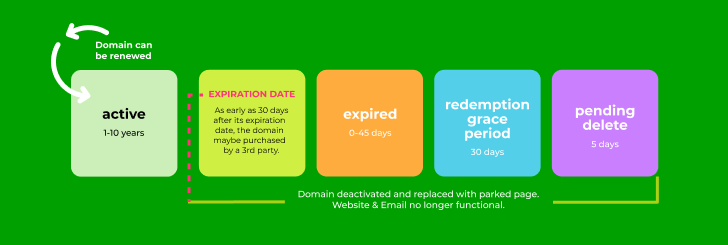
Here are the various stages a domain undergoes when it’s not renewed:
1. Renewal Period(30 days before expiry date)
When your domain registration is still active, you’re within the regular renewal period. As the expiry date approaches, your domain registrar will send you notifications reminding you to renew.
2. Renewal Grace Period (Up to 45 days after the expiry date)
If you fail to renew your domain within the regular renewal period, it will most definitely expire. However, most registrars will give you a short grace period (usually for a few days to a month) to renew it without penalty.
But since your domain has already expired, your website and email functionality can be affected until you complete the renewal process. Additionally, your services will cease to function, and you won’t be able to post any updates.
3. Redemption Period (Up to 30 days after the renewal grace period)
If you still fail to do the domain renewal during the grace period, it will enter a redemption period which goes for 30 days —though this may vary depending on your registrar and domain extension.
During this time, your domain is temporarily held by the registrar. Your domain will be inactive, and additional fees will apply when you renew during this period.
This serves as your final warning, as waiting any longer could lead to permanent loss of domain ownership.
4. Pending Delete (Up to 5 days after the redemption period)
After the redemption period ends, your domain enters a brief “pending delete” phase that lasts for five (5) days. During this phase, your expired domain is queued for deletion and can no longer be reclaimed. Once you’ve reached this phase, you’ll have a slim chance of recovering your domain.
5. Release (Immediately after the domain is deleted)
Lastly, your expired domain will be released back to the open market after the pending delete period. Once released, anyone can register for it, including competitors or domain buyers.
If your domain plays an important role in your brand, buying it once it’s back on the market can be expensive and complicated. So, it’s advisable to complete the domain renewal immediately to prevent further complications.
RECOMMENDED: A Beginner’s Guide on How to Renew a Domain
Secure Your Domain for the Long Haul
Since you can’t own a domain name forever, you can secure it for a longer period with an effective strategy. The best way is to register your domain for the maximum term allowed, enable auto-renewal, and add domain protections like Domain Privacy and Domain Expire Protection.
If you’re exploring other options, blockchain domains offer no-renewal ownership—but with limited compatibility. In most cases, choosing a reliable registrar and following good domain management practices is the perfect technique to secure your online identity for the long term.
Secure your domain now for the long run. Check out Crazy Domains to find the perfect domain plan for you!