| With cybercrime on the rise, Australian websites must secure their connections with SSL certificates to protect customer data and comply with local regulations like the Privacy Act and PCI DSS. Implementing SSL provides a range of benefits, including improved brand trust, higher conversion rates, and a boost to local SEO rankings by enabling secure HTTPS connections. Choosing the right type of certificate and properly installing it is crucial for safeguarding against attacks and ensuring your site is trusted by both users and search engines. |
Millions of cybercrime incidents are reported to Australian authorities each year, yet a significant share of small- and medium-sized business (SME) websites still load over plain HTTP. That gap leaves customer data exposed, search rankings at risk, and brand credibility hanging by a thread. The good news? An SSL certificate can close it, often in less than an hour. This guide explains why SSL is no longer optional in 2025, the exact benefits for Australian organisations, and the quickest way to deploy it.
Understanding SSL Certificate Australia: The Foundation of Trust
Every modern security conversation starts with SSL. This section grounds you in the basics before we dive into business pay-offs.
What Is an SSL Certificate?
An SSL (Secure Sockets Layer) certificate—technically now TLS—scrambles every byte sent between a visitor’s browser and your server, then decrypts it at the other end. The result is the padlock icon and the “https://” prefix customers look for.
HTTPS vs. HTTP—The Security and SEO Gap
Browsers treat the two protocols very differently. Chrome, Safari, and Edge all flag HTTP pages as “Not Secure” and auto-prioritise HTTPS sites in their suggestions. Google has also confirmed HTTPS as a positive ranking factor, meaning secure pages have an intrinsic SEO edge.
The Australian Cyber-Threat Landscape in 2024
Local attackers increasingly spoof .au domains and run man-in-the-middle (MitM) campaigns against unsecured Wi-Fi hotspots. Under Australia’s Notifiable Data Breaches scheme, companies must report certain leaks, often at high legal and reputational cost. A single incident can set an SME back tens of thousands of dollars in response fees and lost business.
| Also Read: Getting Started Guide: SSL Certificates |
7 Business Benefits of SSL for Australian Websites
SSL does far more than add a padlock. The advantages ripple through compliance, marketing, and performance.
1. Protect Customer Data & Privacy Act Compliance
Australian Privacy Principle (APP) 11.1 obliges organisations to take reasonable steps to safeguard personal information. Encrypting in-transit data with SSL is one of the clearest ways to meet that requirement.
2. Strengthen Brand Trust & Conversion Rates
Most shoppers hesitate when a checkout page flashes a “Not Secure” warning. Switching to HTTPS removes that friction and reassures visitors that their payment details are safe, lifting conversion potential.
| Pro Tip: Don’t Use Self-Signed Certificates: While free, self-signed certificates are not issued by a trusted Certificate Authority (CA). Browsers will display a prominent security warning, discouraging visitors and destroying any semblance of trust. They are only suitable for internal or testing purposes. |
3. Boost Local SEO & Core Web Vitals
Google’s search algorithm rewards secure sites. Faster HTTP/2 connections (available only over HTTPS) can also shave milliseconds off load times, supporting Core Web Vitals scores—a known ranking criterion.
4. Enable Secure Online Payments (PCI DSS)
Australian e-commerce businesses must follow the Payment Card Industry Data Security Standard. Requirement 4-1 explicitly calls for encryption of cardholder data during transmission, precisely what SSL provides.
5. Safeguard Against Man-in-the-Middle (MitM) Attacks
In a well-publicised 2023 incident, attackers intercepted café Wi-Fi traffic in regional NSW, injecting malicious scripts into unsecured sites. SSL/TLS foils that tactic by preventing third parties from reading or altering sessions.
6. Qualify for Browser & Platform Integrations
Initiatives such as Accelerated Mobile Pages (AMP), Progressive Web Apps (PWAs), and HTTP/2 all insist on HTTPS. Without SSL, your site is locked out of these performance-boosting technologies.
7. Publicly Display Trust Seals & Warranty Coverage
Premium certificates often include a warranty that covers certain damages if encryption fails, sometimes into the seven-figure range. The associated trust seal can give risk-averse buyers an extra nudge.
| Also Read: The Crazy Easy Guide to SSL |
How SSL Encryption AU Works – A Layman’s Walk-Through
SSL may feel abstract, but its mechanics are straightforward once broken down.
The SSL/TLS Handshake in 5 Steps
- ClientHello: The browser proposes encryption suites.
- Server Certificate: Your server presents its SSL certificate.
- Key Exchange: Both parties generate session keys.
- Finished Messages: They confirm key integrity.
- Encrypted Data Flow: Secure communication begins.
Symmetric vs Asymmetric Encryption Explained
SSL employs asymmetric encryption (public/private keys) to start the conversation, then switches to symmetric encryption (a shared session key, typically 256-bit AES) for efficiency.
OCSP Stapling & HSTS—Extra Security Layers
OCSP stapling lets the server “staple” proof of certificate validity, reducing lookup time. HTTP Strict Transport Security (HSTS) tells browsers to refuse future HTTP connections, eliminating downgrade attacks.
Types of SSL Certificates Available in Australia
Different business models demand different validation levels and scopes.
DV (Domain Validation) – Fast, Basic Padlock
Domain Validation verifies control of the domain only. Issuance is near-instant, ideal for blogs and portfolio sites.
OV (Organisation Validation) – Company Identity Displayed
Certification Authorities (CAs) check the organisation’s legal existence. Most SMEs and non-profits choose OV to reassure users.
EV (Extended Validation) – Green Bar + Legal Entity Name
EV triggers the company name in the address bar on some browsers, signalling rigorous background checks, valuable for finance or healthcare sites.
Wildcard SSL – Protect *.yourdomain.com.au Sub-Domains
A single certificate secures unlimited first-level sub-domains, e.g., shop.example.com.au, mail.example.com.au.
Multi-Domain (SAN/UCC) – Ideal for Agencies Hosting Clients
One cert covers multiple unrelated domains—handy for digital agencies or enterprise groups with a mixed portfolio.
How to Choose & Buy an SSL Certificate in Australia: A Decision Checklist
Making the right purchase starts with structured questions.
Assess Your Site Architecture
Count how many root domains and sub-domains you operate and forecast traffic volumes. A content network with dozens of sub-domains may warrant a wildcard or multi-domain option.
Map Compliance Requirements
If you process payments (PCI DSS), handle health data (HIPAA), or work toward ISO 27001, make sure your certificate type and CA reputation satisfy auditors.
Budget vs. Risk Matrix for SMEs, Agencies, Enterprises
Small brochure-style sites can begin with a free DV certificate. High-transaction platforms may prefer premium SSL for the larger warranty and visible trust indicators.
Implementation Guide: From Purchase to Padlock
Here’s the practical roadmap from checkout to full HTTPS.
Buying vs. Free SSL: Pros, Cons & Use Cases
Free certificates (e.g., via Let’s Encrypt) cover basic encryption but lack extended validation and sizeable warranties. Paid certificates deliver stronger visual cues and liability coverage.
Step-by-Step Installation
- cPanel/WHM: Use the AutoSSL wizard—upload the certificate, click “Install”, and your domain switches to HTTPS automatically.
- WordPress: Install the “Really Simple SSL” plugin to update site URLs and handle mixed content.
- NGINX & Apache: Upload cert and key, then configure ssl_certificate and ssl_certificate_key directives (NGINX) or SSLCertificateFile (Apache). Reload the server to apply.
Post-Install Tasks
- Force HTTPS redirects via .htaccess or server blocks.
- Run mixed-content scans to ensure all assets load over HTTPS.
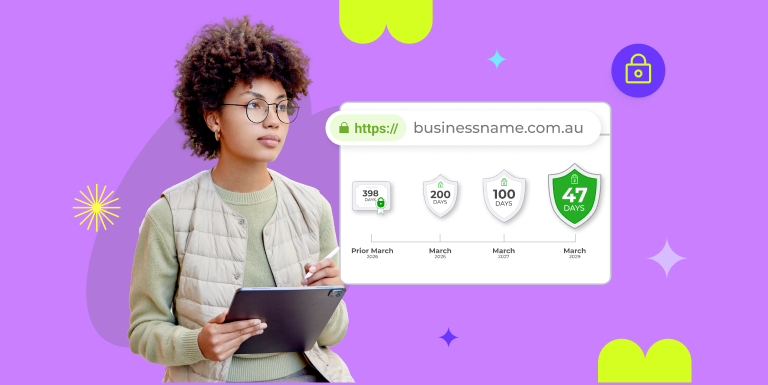
- Set up renewal reminders or enable 90-day ACME automation to prevent lapses.
Common Myths & Mistakes Australian Site Owners Make
“My site is informational; I don’t need SSL.”
Any login form, contact page, or analytics cookie transmits data worth protecting. Search engines also expect HTTPS by default.
“SSL will slow my website.”
Modern CPUs handle SSL handshakes efficiently, and HTTP/2 over TLS often improves overall speed.
Letting Certificates Expire—Impact on SEO & Trust
An expired SSL throws a red warning screen, driving visitors away and prompting search engines to drop rankings temporarily.
Installing on www Only, Forgetting Root Domain
Secure both example.com.au and www.example.com.au to stop browser warnings on naked domains.
Measuring Success After Deploying SSL
Track KPIs
Monitor bounce rate, checkout completion, and average session time. Improvements often appear once browser warnings disappear.
Security Metrics
Run a Qualys SSL Labs scan and aim for an “A” rating. Confirm browsers no longer flag mixed-content issues.
SEO Metrics
Watch keyword positions over the next 60 days; many sites see gradual lifts after migrating to HTTPS.
Conclusion & Next Steps
Switching to SSL is the fastest, most cost-effective way to protect customer data, meet Australian regulations, and unlock performance perks like HTTP/2. Don’t leave your reputation to chance.
Secure your site and your customers with a click. Stop risking your brand and your data to plain HTTP. Crazy Domains offers a range of SSL certificates to fit any Australian business, from instant DV certificates to premium EV options with a massive warranty. Get crazy with your security, not your risks.