| To build a high-converting landing page for the Australian market, leverage a .au direct domain for instant local credibility and SEO benefits. Combine this with classic conversion optimisation techniques, such as a strong, benefit-oriented headline, fast page speed, and mobile-first design, to create a relevant and trustworthy user experience. Finally, integrate the page into your wider marketing funnel with clear analytics and A/B testing to continuously improve performance and ROI. |
Australian consumers can spot a throw-away page in seconds. They judge design, speed, and copy, and often overlook the domain that appears in their browser bar. When your landing page feels local, loads fast, and answers a single, burning need, clicks turn into revenue. This guide shows enterprises, SMEs, and digital agencies exactly how to combine world-class landing page optimisation with the instant trust of a .au direct domain so you can launch or relaunch a page that converts.
Why Landing Page Optimisation Is Critical for Australian Brands
A great landing page turns paid and organic traffic into measurable profit. Every misaligned headline, slow load, or confusing form leaks the budget you’ve already spent acquiring that visitor. In today’s crowded local market, even a tiny uplift in conversion rate (CVR) can swing your return on ad spend (ROAS) from average to outstanding. Optimised pages also dovetail with full-funnel thinking: the smoother the experience from ad click to thank-you page, the easier it is to attribute, forecast, and scale your marketing investment.
The Hidden Power of Your Domain in Conversion Funnel Optimisation
Before colours, copy, or code, visitors scan your URL. A clean, local-looking web address sends a quiet but powerful signal that they’re in the right place and that you’re a trusted Australian business.
What is a .au Direct Domain?
A .au direct domain is the shortest possible Australian namespace. Launched in March 2022, it drops the second-level label—such as “.com” or “.net”—so yourbrand.au stands on its own. That brevity makes it easier to remember and faster to type than traditional domains like yourbrand.com.au.
.au Domain Benefits for Conversions
- Instant local credibility: Shoppers are almost twice as likely to buy from a site that looks Australian compared with an international URL
- Shorter, more memorable addresses: Fewer characters improve recall and reduce typing errors, especially on mobile.
- SEO edge for “near me” intent: Google’s local algorithm weighs ccTLDs such as .au as a location cue.
- Visual trust: Seeing .au right in the browser bar complements other badges like SSL and third-party reviews.
Pre-Build Checklist: Nail the Foundation Before You Design
Optimisation starts long before you drag a single content block into place.
- Clarify one goal – Decide whether the page chases a demo booking, instant purchase, or quote request.
- Define one primary persona – Enterprise procurement officers read differently from SME owners. Write for one.
- Summarise your value in one sentence – Every element should reinforce this promise.
- Plot the exact funnel stage – Are prospects in research mode or ready to buy? Align messaging and risk-reversal accordingly.
| Also Read: Connect Your Domain to Your Crazy Domains Website |
Step-by-Step Guide: Building a Landing Page That Converts on a .au Domain
Each of the following ten steps layers conversion best practice with distinctly Australian cues so your page feels relevant the moment it loads.
1. Secure Your .au Domain Early
Lock in every close variation of your brand name before someone else does. A single registration protects funnels, email deliverability, and future campaigns.
2. Choose the Right Platform or Framework
No-code builders like Elementor and Webflow get you live fast, while a bespoke framework offers full control. Whichever route you pick, host on Australian servers to shave milliseconds off latency and improve Core Web Vitals.
3. Craft a Magnetic Headline & Sub-Headline
Keep the main headline under 12 words and laser-focused on a benefit:
“Cut Shipping Costs for Aussie Customers in 24 Hours.”
Back it up with a sub-headline that clarifies how, without jargon.
4. Design an Impactful Above-the-Fold Section
Place your primary call-to-action within the first 600 px so it’s visible on virtually every laptop. Use hero imagery that feels familiar—think Bondi storefronts, Melbourne cafés, or regional backdrops. On mobile, stack elements vertically and ensure tap targets meet the 48 px guideline for a mobile-friendly landing page design
5. Write Persuasive, Skimmable Copy
Readers skim. Use short paragraphs, bold phrases, and bullet lists to surface value quickly. Lead with pains solved, then show features. Replace “state-of-the-art logistics platform” with “deliver next-day to any Aussie postcode.”
6. Showcase Trust Signals
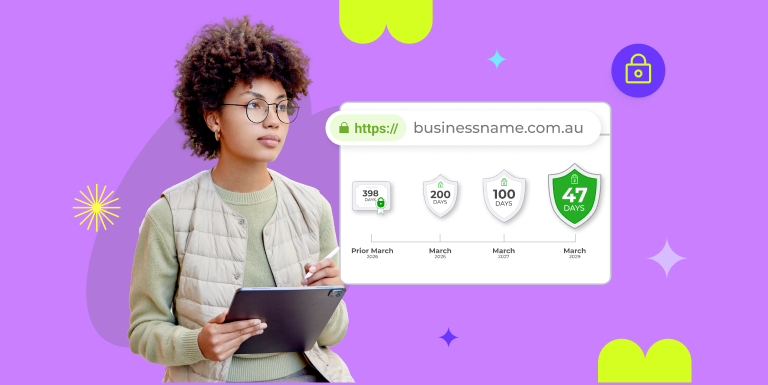
Display your .au URL prominently in the address bar and mirror that local trust with client logos, SSL badges, and real testimonials.
| Also Read: Getting Started Guide: SSL Certificates |
7. Optimise Your Form & CTAs
Use action-oriented copy, “Get My Free Audit” and pick a button colour that contrasts with the rest of the page while meeting WCAG AA contrast ratios for accessibility.
8. Maximise Page Speed & Core Web Vitals
Compress hero images into WebP or AVIF, lazy-load anything below the fold, and serve static assets via a CDN with Australian nodes. Faster load times correlate with both higher CVR and better organic rankings.
9. Ensure Mobile-First Responsiveness
Build and preview on a mobile viewport first, keep clickable elements thumb-friendly, and avoid fixed-width elements that break on smaller screens.
10. Install Analytics & Launch A/B Tests
Set up GA4 events to capture clicks, scroll depth, and form submissions before you go live. Once traffic flows, split-test headlines, imagery, and if you have the inventory, identical pages on .au versus .com to validate the domain uplift empirically.
Integrate the Landing Page Into Your Wider Conversion Funnel
A landing page is only as strong as the ecosystem surrounding it.
Traffic Acquisition
Map paid search, social, and email campaigns to clear UTM parameters so you can trace every dollar back to its click.
Retargeting & Personalisation
Insert dynamic content blocks that swap headlines for returning visitors and pre-fill forms from your CRM. This reduces friction and lifts repeat-visit conversion rates.
Post-Conversion Experience
Use your thank-you page to recommend complementary offers and trigger an email nurture sequence.
Compliance & Trust: Meeting Australian Privacy Standards
Australian businesses must align with the Privacy Act 1988, the Spam Act 2003, and state-based data residency guidelines. Always secure explicit consent for marketing emails, implement a transparent cookie banner, and design towards WCAG 2.1 AA accessibility so every user feels included.
Rounding Off
A high-converting landing page only reaches its full potential when paired with the trust and clarity of a .au direct domain. Register your .au, launch a minimum viable page built on the ten steps above, and schedule your first A/B test within seven days. Ready to launch? Register your .au and start optimising with Crazy Domains today.