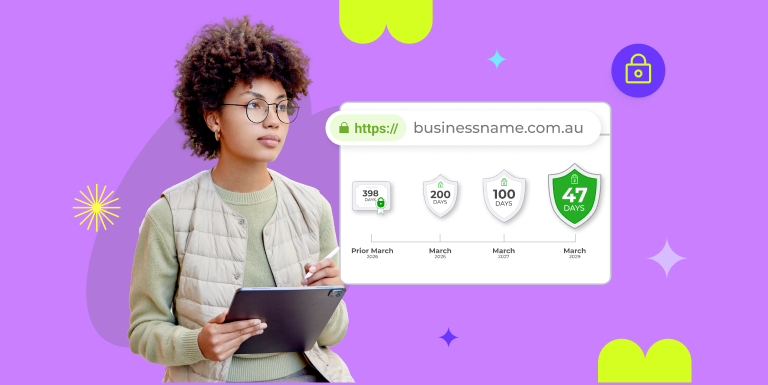
| Full stack refers to the complete set of technologies required to launch and operate a digital presence, including domain registration, hosting infrastructure, CMS, email, security, and basic SEO. For SMBs, a lean full stack enables rapid launch, early lead capture, and future scalability without locking the business into complex or irreversible technical decisions. |
Launching quickly matters. The sooner a site can accept an enquiry, the faster cashflow and proof of demand follow.
Instead of waiting months for a custom build, an Australian small business can assemble a lean but future-ready stack in a single week: compliant domain setup, managed hosting with a familiar CMS, one focused landing page, professional email, baseline security and targeted basic SEO. Every choice is practical, measurable and easily reversible if requirements grow later.
Day 1: Domain Selection and Australian Compliance
A legally sound .com.au or .net.au domain underpins local trust and search visibility. Australian registrants must prove an exact match or close connection between the chosen name and a registered ABN or ACN. Skipping this step risks later suspension.
Naming for discoverability should be clear, brand-aligned and easy to spell; clever puns rarely help phone or email conversions.
Domain setup checklist (complete on Day 1):
- Register with accurate business name and ABN/ACN details.
- Enable automated renewals and confirm admin/technical contacts.
- Add basic DNS placeholders (A record, CNAME) so hosting connects instantly.
Risk controls:
If an eligibility or trademark conflict surfaces, document two alternative names and reserve one interim domain to avoid schedule slippage.
Day 2: Choose Managed Hosting and a Simple CMS
Managed hosting with a mainstream CMS is the fastest route from purchase to page. One-click SSL, automated backups and server-side caching eliminate early technical hurdles. WordPress or a builder platform with exportable content lets you launch today and migrate later.
Selection criteria that favour speed-to-lead:
- Proven uptime, Australian-based support and one-click staging.
- Mobile-first templates, CDN or built-in caching for quick loads.
- Clear migration path so content is never locked in
Quick setup tasks:
Provision hosting, install the CMS, pick a mobile-responsive template with an embedded form, enable SSL and caching, then run a mobile performance test.
Portability note: schedule weekly database and file exports so an unexpected provider issue never stops you moving.
Day 3: Build a High-Converting Landing Page
One page can do all the early heavy lifting. Structure it around a single promise, a single call to action and a short contact form.
- Headline: Blend a service keyword with your suburb or city to mirror local search intent.
- Benefits-led copy: Use tight paragraphs plus trust signals such as ABN display, concise testimonials or client logos.
- Form: Name, phone, email and an enquiry box keep friction low. Wire the form to both email and a CRM/webhook so leads appear in your workflow immediately.
- Measurement: Add Google Analytics and define one conversion goal; tag any paid traffic with UTM parameters for clarity.
Content portability: store form submissions and a full page export externally each evening.
| Pro Tip: Create a lightweight pricing guide or checklist, gate it behind the form and automate delivery via email; it boosts conversions without extra design work. |
Day 4: Professional Email Setup and Deliverability
Customers trust messages that arrive from an address matching the domain on the landing page. Domain-based mailboxes also reduce spam flags when configured correctly.
Email setup checklist:
- Create core mailboxes (e.g., hello@, accounts@).
- Publish SPF, DKIM and DMARC records to harden deliverability.
- Activate multi-factor authentication on admin accounts.
Provider considerations: Select an email host with a stated SLA, easy webmail/IMAP access and built-in retention so critical correspondence is never lost.
Day 5: Basic SEO and Local Signals That Drive Immediate Visibility
Local intent dominates most early searches. Start with on-page optimisation:
- Craft a concise page title, meta description and H1 that pair service and location.
- Keep NAP details identical across the site and any directory entry.
- Use clean, descriptive URLs and add LocalBusiness schema for clarity
Google Business Profile: Claim, verify and populate your profile with service categories, opening hours, photos and a link to the landing page. Then replicate accurate details across key local directories.
Day 6: Security and Operational Best Practices
A hurried launch cannot ignore risk. Opportunistic attacks on fresh domains are common.
Essentials to complete today:
- Enforce SSL site-wide and auto-renew.
- Turn on MFA for hosting and email; store strong, unique passwords in a manager.
- Enable daily backups and run a restore test.
Keep the CMS lean and updated, limit admin accounts and record a two-step incident plan: who to call and how to restore from the latest backup.
Day 7: Drive Your First Traffic and Measure Leads
With the stack in place, it is time to switch on traffic.
Low-friction channels:
- Optimised Google Business Profile plus local directory links.
- Organic social posts to existing contacts.
- Highly targeted local search ads routed to the landing page if budget permits.
Conversion monitoring: Watch form submissions in real-time, note response speed and track lead-to-call ratios. Small A/B tweaks, CTA text, form length, and hero images often lift conversions quickly.
Early qualification workflow: Feed every lead into a spreadsheet or simple CRM, tag the source and commit to a 24-hour reply window. Rapid follow-up turns curiosity into booked work.
Full Stack: Your 7-Day Path From Domain to First Lead
A compliant domain, managed hosting with a familiar CMS, a single high-converting landing page, professional email, baseline security and focused local SEO combine to deliver the fastest, most option-preserving route to measurable leads for an Australian SMB. Following this sequence slashes technical debt, builds credibility and keeps every component portable as the business scales.
Ready to act? Secure a compliant .com.au domain, pair it with managed hosting and publish your lead-first landing page this week. Secure your domain with Crazy Domains and start capturing enquiries today!